
D&D 5e: The Dungeon Delver Feat: Trap Choice Or Hidden Treasure?

D&D 5e: The Dungeon Delver Feat: Trap Choice Or Hidden Treasure?
SOURCE: Player’s Handbook
Rating the Benefits of Dungeon Delver
Benefit #1 –
Advantage on Perception and Investigation checks to find secret doors
Secret doors are a fun and frustrating mechanic in equal measure. Advantage on Perception is a strong feature that really helps find every last secret, especially for a character who already has a high skill bonus
Benefit #2 –
Advantage on saving throws to avoid and resist traps
Many traps have a reasonably low save DC, to give most characters at least a shot at passing the saving throw. Advantage on the roll goes a long way to making a pass more likely than a failure.
Benefit #2 –
Resistance to damage from traps
Traps can be a lethal threat, generally dealing far more damage in a single instance than any appropriate CR rated monster. Resistance to any trap’s damage makes a character twice as tough, which is a massive boost to durability.
Benefit #2 –
Traveling at a fast pace doesn’t impose a -5 penalty on Perception checks
This feature refers to a rules system that didn’t make it through to the final edition of 5e. You can safely ignore it. More on this later in the article.
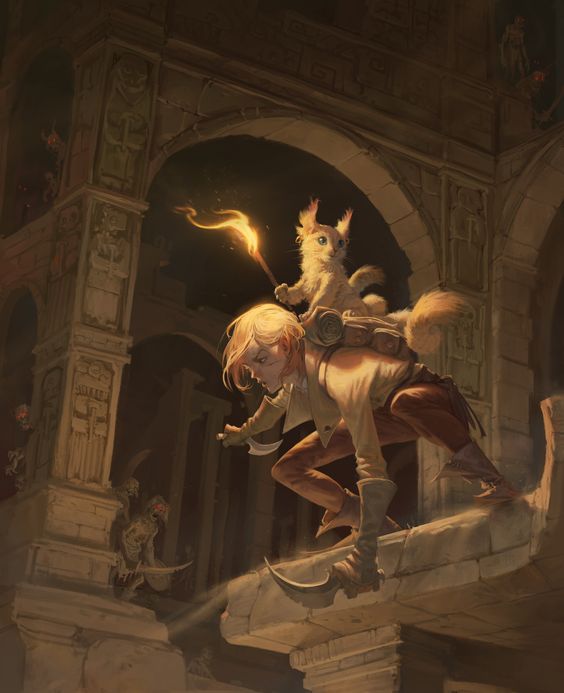
Mechanics and Requirements
Understanding How It Functions
The Dungeon Delver feat splits its features between four main abilities:
Advantage to find secret doors
Gaining advantage on any skill check is always a powerful ability. Especially when trying to search for things that might be hidden from casual observation.
The issue is, in 5e, secret doors are a complicated beast. Some GMs will ask the party to roll a dice to see if they spot anything. Some may roll in secret for the party.
But some secret doors will only ever be found through player deduction and intelligent observation of surroundings.
On top of this, it’s worth thinking about how often this specific situation comes up in your campaigns. Your erstwhile writer has been playing tabletop games for a long while. The last campaign I played lasted several months, and I can’t recall a time when a secret door played a major part in any of the events.
Like many of the features this article is going to discuss, the first part of the Dungeon Delver feat is campaign reliant, and you’ll generally know if you’re gonna be needing it.
Advantage on saves against traps
As we’ve already said, advantage is an incredibly strong benefit for a character to have on their rolls.
Flat advantage on all traps is a fantastically powerful buff that massively increases the chances of a character making saves.
Many traps that deal damage only deal half on a successful saving throw.
This feature is especially powerful for classes that gain the Evasion feature, which allows the character to take zero damage against effects that require a Dexterity saving throw. Rogues and Monks innately have this feature, and other characters can pick up essentially the same feature with the Shield Master feat.
Like every feature of the Dungeon Delver feat, the power of this feature heavily depends on a campaign’s style. If the party ventures into heavily trap-infested ruins and creature lairs, this is amazing. Even if just to walk face-first into every trap and safely eat the damage.
If, like many parties, traps are an occasional thing, and heavily lampshaded before they arrive so the party can prepare, this feature quickly drops off in value.
Resistance against traps
In D&D 5e, resistance cuts damage from the specific source resisted in half.
This is incredible when it’s needed because traps can have some truly absurd damage numbers. A basic example mechanical trap is a collapsing roof, which can be noticed by simple observation and has a DC15 check to disarm.
These aren’t hard tests. DC15 is achievable at level 1 with a 50% chance for any unoptimized character. A level 1 Rogue with Expertise and the Guidance spell, not a crazy ask for a good party, will pass this test 3 out of 4 times.
How much damage does this simplistic, easily disarmable trap do? 4d10, or an average of 22. Enough to squash a character up to level 3 flat, or seriously threaten a character up to around level 5 or 6.
Dungeon Delver slashes that damage in half, without having to roll, reducing the damage taken to a much more manageable 11, 5.5 on a successful saving throw.
As we’ve said with every feature of this feat, while this looks incredibly useful at first glance, the utility is almost entirely reliant on your campaign. If traps are a regular occurrence, this feature is incredible. If you might see one trap every third dungeon, then much less so.
Moving faster when searching
Hey, look, a mistake!
The Player’s Handbook version of the Dungeon Delver feat shipped with rules that should have been removed before publishing. In earlier editions of 5e, a party searching for traps moved at a slower pace, but this rule didn’t make it through to the final version.
So, uh, ignore this. Unless your GM likes introducing funky house rules.
Key Stats
Trapfinding and disarming require two stats: Wisdom and Dexterity.
Wisdom dictates a character’s Perception bonus, essential for spotting things before they kill you.
Dexterity, on the other hand, is the stat that governs a character’s ability to disarm traps and use Thieves Tools. Conveniently, many traps also target Dex saves, especially those that deal heavy damage, so more points here is often the smart play.
Ideal Characters for Dungeon Delver
Top Classes
Rogue – The Rogue class gains access to Expertise at level 1, doubling chosen skill proficiencies, and is one of the only ways for a character to get Expertise in Thieves Tools to disarm traps.
Every subclass of Rogue is great for trapfinding, but the Arcane Trickster is probably the best class in the game in its lane. Disarming Traps from 30ft away with Mage Hand turns most traps into an utter joke, even if the roll is failed and it goes off.
Artificer – Another class that’s naturally great with tools, as well as having access to various spells and abilities that can help with trap finding and disarming. From its familiars, expendable summons, and robot companions, to Expertise in damn near every crafting tool available, which a good GM will roll into skill use, Artificers are exceptional at building, and subsequently deconstructing, almost anything.
Druid – Specifically, Moon Druids. Combine a high innate Wisdom score for great Perception checks with the ability to shapeshift into a chonky animal form with a pile of HP to take the damage from failed trap rolls.
Race or Subrace Choices
Variant Human – Pretend you’re Indiana Jones and take Dungeon Delver from level 1.
Kenku – Pick two skills. Gain proficiency in them. Turn on advantage for skill checks multiple times per day, at will. If your class is bad at skills, the Kenku fixes that.
Halfling – No one likes rolling 1s. Any Halfling can reroll critical failures an infinite amount of times per day, turning awful situations into possible success. The racial feat lets a character extend the feature to allies, in case you were smart enough to not volunteer for bomb disposal duty.
Combos, Tactics, and Synergies
Complementary Feats
Shield Master – Boost AC against single target effects that require a Dex save, like dart traps, and also gain proto-Evasion, using your shield to block damage from Dexterity-based AOE damage.
Observant – +5 to passive Perception on an appropriate character means almost nothing goes without notice. Combine with the advantage granted by this feat (another +5 to passive) to never miss anything, ever again.
Resilient – Proficiency in a saving throw can be a powerful tool, especially the saves used most often, and stacks nicely with the advantage in saves against traps granted by this feat.
Spells that Synergize
Unseen Servant – The servant can do simple tasks a human servant could do. That includes pulling levers, opening chests, applying force to pressure plates, or any of a dozen other ways to trigger traps.
Any Summon – Summoned creatures can effortlessly trigger traps, as long as your party is fine with the Druid clearing a dungeon by sending an endless swarm of kittens into life or death situations.
Mage Hand – Open doors and check suspicious areas from 30 feet away with the power of your mind. Synergizes extra-double well with an Arcane Trickster Rogue.
Bless/Guidance – When things go wrong and you have to take a saving throw, a boost makes it that much more likely to pass.
Strategies for Maximizing Dungeon Delver Effectiveness
Maximizing Perception
To open a secret door or defeat a trap, first, the party has to know it exists.
Dungeon Delver is a great start, giving a character advantage on rolls to detect secret doors. But there are many ways to make this even stronger, including:
- Gaining advantage on Perception or Investigation rolls in general, to find traps, deduce clues, spot signs of enemies passing, and more.
- Taking the Observant feat to push passive Perception to ridiculous levels.
- Spells like Guidance, and abilities like Bardic Inspiration, for further bonuses on the roll.
Extranormal Senses
So your party has members with a high Perception score who should be noticing everything that’s around them. What next?
What about traps that are beyond the range of normal, humanoid senses?
The most basic special sense is Darkvision. Most dungeons, unsurprisingly, have little in the way of natural light, so seeing what’s going on if the torches go out is an essential skill. Many races come with Darkvision, and there are a dozen classes and spells that also offer it, allowing a character to venture into the darkest dungeon and come out unscathed. Maybe.
Another option is Blindsight, offered by several class abilities, most notably the Blind Fighting fighting style, which can be gained via several classes, or by taking the Fighting Initiate feat.
This gives a character awareness in a limited radius around themselves without relying on conventional senses. Examples, where this might be useful, are trap triggers hidden under something like a chair or on the other side of a door that has a gap under it or a barred window.
Trap Avoidance
It’s worth remembering that in a lot of cases, you don’t have to trigger the trap.
A party with a few levels behind it probably has a dozen ways to approach any problem. We’ve already touched on this in the article with spell choices and summons, but consider how things like flight or the Spider Climb spell might get a character past a problem.
Is the trap possible to defeat in other ways? Directly attacking it, for example? How do you think a series of elaborate poison gas traps contained in ceiling vents might stand up to a Fireball? Does the party have access to a trigger mechanism? The Shape Water cantrip could allow the party to freeze it solid, with a little help from a full waterskin.
In many cases, traps are a test of player ingenuity as much as they are game mechanics. Don’t be afraid to approach problems obliquely. Worst case scenario: Your GM says no, the trap triggers, and you get to make a saving throw with your shiny advantage on the roll and resistance against damage!
Final Thoughts on Dungeon Delver
Whether Dungeon Delver is a good feat is highly reliant on the campaign that you’re playing.
If your GM is the sly, devious type that loves stacking lethal deathtraps into every room of a dungeon. If your party ventures into ancient ruins packed with tricks around every corner. If you’re playing OSR (old school roleplay) style games where one mistake can mean death. Then Dungeon Delver on at least one character in the party might save your party’s skin a dozen times a session.
But this situation doesn’t describe most campaigns, and the benefits of this feat are very very niche, only benefitting a character in specific, exacting situations. Most parties or builds simply won’t see enough benefit from Dungeon Delver for it to be worth taking, and that’s a shame.